 Home
Home

News and opinions

Cosatu after 40 Part 2: The implications of multi-sectoralism for COSATU’s centralised bargaining aspirations
Until the reforms to labour legislation initiated in 1979, almost all the trade unions that formed the Congress of South African Trade Unions (COSATU), the National Council of Trade Unions (NACTU), and the Council of Unions of South Africa (CUSA) were excluded from participating in industrial councils. These unions had therefore pursued a plant-level collective bargaining strategy that enabled them to maximise their bargaining power and worker control. After the reforms, the new unions had to decide whether they would continue to bargain mainly at plant/enterprise level or participate in industrial councils. The option of bargaining at both levels was more or less excluded because it was so strongly opposed by employers.
A brief history of COSATU and centralised bargaining
Until the reforms to labour legislation initiated in 1979, almost all the trade unions that formed the Congress of South African Trade Unions (COSATU), the National Council of Trade Unions (NACTU), and the Council of Unions of South Africa (CUSA) were excluded from participating in industrial councils. These unions had therefore pursued a plant-level collective bargaining strategy that enabled them to maximise their bargaining power and worker control. After the reforms, the new unions had to decide whether they would continue to bargain mainly at plant/enterprise level or participate in industrial councils. The option of bargaining at both levels was more or less excluded because it was so strongly opposed by employers.
The step up to the industrial council level saw the new unions facing opposition from employers across the table and often from established unions on their own side of the table.1 However, there were compelling factors that favoured a shift to industry-level bargaining, in particular the rapid growth of the unions and the pressure this placed on their capacity to bargain at numerous plants/enterprises. Another consideration was the strategic objective to reduce wage differences between members across enterprises in the same industry. A third factor was that industrial council agreements could be extended to all workers within the jurisdiction of a council.
As noted above, there were differences between the new unions on this issue, with the Federation of South African Trade Unions (FOSATU) deciding in 1982 that its affiliates could participate in the industrial council system subject to certain conditions (FOSATU Central Committee, 1982, pp. 81-85). When COSATU was established in 1985 the growing preference for bargaining in industrial councils, in a statutory system that sought to promote industry-wide bargaining, aligned in theory with its founding principle of ‘one industry, one union’.
However, although labour legislation had aimed to promote industry-level bargaining, in reality the industrial council system that the unions confronted was a patchwork of mainly local and narrow sub-sectoral councils, with only a few having achieved a national industry-wide footprint. The reason was that the legislative framework for industrial councils had enshrined voluntarism as the basis for participation, i.e. there was no legal compulsion to bargain in an industrial council. Participation was therefore by agreement between employers and union(s) or, failing that, pressure on a party through the exercise of power (e.g. a strike).
The other key principle underpinning the system was the need for the parties to a council to be sufficiently representative before the council could be registered. Voluntarism and representativity meant that a council’s scope could be only as wide as the membership of the parties that constitute it. Given the relatively weak organisation of employers and trade unions across the country (compounded by the exclusion of African workers from the system), the centralised bargaining system that had emerged fell well short of national industry-wide bargaining (Godfrey, 1992, pp. 27-29).
As the merger process within COSATU to establish national industrial unions proceeded, the misalignment of the unions with the fragmented industrial council system became more evident and problematic. The growing commitment of COSATU to a coherent system of centralised bargaining therefore translated into a strategy to reconstitute the patchwork of industrial councils into a demarcated system of industry-wide national bargaining structures.
COSATU, however, faced strong opposition. As unions representing African workers started joining industrial councils, employers started leaving them. Some were influenced by the global trend to decentralise collective bargaining, while others were put off by the militancy of the new unions. Voluntarism facilitated employers’ exit from industrial councils and the system entered a period of instability, with the new Industrial Court struggling to fashion a consistent jurisprudence to resolve disputes over the level of bargaining (Godfrey, 1992, pp. 31-32; Du Toit et al., 2023, pp. 14-15).
As a result, the industrial council system changed significantly in the period after the labour reforms of 1979 to 1981. In 1978, just before the reforms were implemented, there were 101 councils, of which 78 were relatively small local/regional councils, with only 13 having national boundaries (some of which had very narrow sub-sectoral scopes and did not cover many workers). By 1992, following a decade in which the presence of COSATU and NACTU unions on industrial councils increased, the number of national councils had fallen to only seven and the total number of councils stood at 85. By then, however, COSATU had become strongly committed to industry-wide bargaining (Du Toit & Godfrey, 2025, pp. 791-792).
The level at which bargaining took place was therefore one of the most contested labour relations issues in the years leading up to the negotiation of the new Labour Relations Act and it became one of the most contentious in the National Economic Development and Labour Council (NEDLAC) negotiations. Labour (i.e. COSATU, NACTU and the Federation of South African Labour Unions (FEDSAL) argued for the introduction of a statutory duty to bargain and for the Labour Relations Act to establish bargaining councils (the proposed new name for industrial councils) in each industry, with NEDLAC demarcating the boundaries.2 A union in a demarcated industry would be entitled to representation on the bargaining council once it reached 30% membership within the scope of the council. Bargaining on the council, however, would be triggered only when the union(s) on the council reached majority representativity (Du Toit et al., 2023, p. 27). Implicit in this schema was the rejection of voluntarism, which was directly at odds with organised business’s position, with government more or less neutral.
It was impossible to fashion a compromise on this issue and, ultimately, it was won by employers. Voluntarism was retained in the new Act, with the sop to unions being provision for the establishment of statutory councils, which is an uneasy blend of voluntarism with elements of compulsion that has proved unpopular. In addition, the new Act included the public service within its ambit and provided it with a set of dedicated provisions to establish bargaining councils which in effect created a duty to bargain in the sector (Du Toit et al., 2023, p. 322). The implications of this change for the collective bargaining system were probably not anticipated at the time.
After the introduction of the new Labour Relations Act the number of councils continued to decline, but this was primarily because of a consolidation of bargaining councils through mergers rather than due to the collapse and de-registration of councils (although the latter continued). The result was fewer but bigger bargaining councils, with the coverage of the system increasing significantly. The increased coverage was in large part because of the inclusion of the public service and the huge growth of public sector unions, although private sector bargaining council coverage also increased. By 2020, there were 41 bargaining councils,3 of which 21 were national councils and only 13 were small local or regional councils. The coverage of workers by the system stood at just over three million (compared to less than one million in 1992). Total coverage was split almost 50/50 between the private sector and the public sector (i.e. the public service and local government councils).4
Clearly the consolidation of national, industry-wide bargaining councils and the increase in the number of workers covered are major gains for labour. There are other positive signs, such as the establishment of some new councils (e.g. the civil engineering council in 2012 and the large private security council in 2018), but the system still faces major challenges. There are, for example, ten bargaining councils that ceased to function as bargaining forums some years ago and exist only to administer social security funds and/or provide dispute resolution services. There are, furthermore, large sectors in which there is no bargaining council, and little likelihood of one being established (e.g. agriculture and retail). There are also key industries like construction in which bargaining councils have an insignificant presence (Du Toit et al., 2023, p. 61; Du Toit & Godfrey, 2025, p. 794). The question is, how could COSATU address these challenges, given the weakening of its industrial unions in the private sector and the trend towards multi-sectoralism?
Recent research on COSATU and the bargaining council system
In the following section, private sector and public service bargaining councils are dealt with separately, given how different their circumstances and growth trajectories are (to the extent that they arguably constitute two distinct sub-systems). In the private sector, the retention of a voluntarist legislative framework meant that any attempt by unions to reconstruct the bargaining council system into one comprising national, industry-wide councils will require rising union membership and representativity at the industry level. Data obtained during research has made it possible to track union representativity over time and to unpack representation across the bargaining council system by union in 2020. This makes it possible to ‘measure’ COSATU’s presence and ‘weight’ in the system.
The data shows, first, that union representativity in private sector councils has declined steeply over time. Research conducted in 2004 found that employer parties on bargaining councils had an aggregate 63% level of representativity,5 whereas party trade unions had a 60% level of representativity (Godfrey et al., 2006, p. 26). So employers and unions across the system had similar levels of representativity and both were comfortably representative (using 50% as the threshold). Ten years later, the representativeness of party employers had barely changed but union representativity had dropped sharply. A more recent sample of 16 major private sector bargaining councils provides data on employer and trade union representativity in 2020.6 It showed that aggregate trade union representativity was 33%, whereas employers had improved their aggregate representativity marginally to 63.6%. Over a period of less than 20 years, employers’ representativity in the system was therefore almost unchanged, whereas the representativity of trade unions had declined significantly (to the point of being unrepresentative).
The aggregate representativity of trade unions in the private sector bargaining council sub-system at which trade unions are not 50% representative for 2004, 2014 and 2020 are presented in the table below.
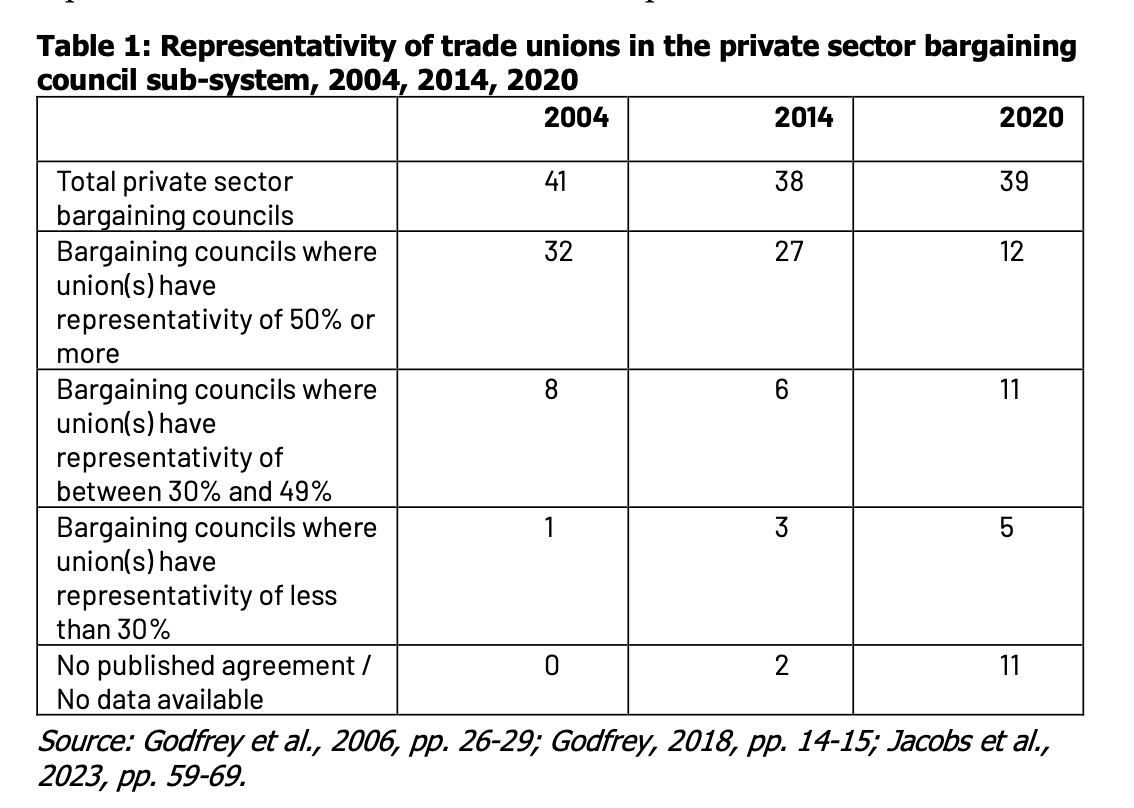
The table shows that while the number of private sector bargaining councils has varied slightly, the number of councils at which party trade unions are representative (i.e. 50% or more) has declined steeply: from 32 in 2004 to 12 in 2020. At the same time, the number of councils at which party trade unions are not representative, but represent 30% or more workers, has risen, as has the number of councils at which unions have less than 30% representativity.8
Given this finding it is sobering to reflect on the 1995 proposal made by COSATU, NACTU and FEDSAL in the negotiations for the new Labour Relations Act, that within the proposed demarcated system of bargaining councils a union would obtain representation on a council once it had 30% representativity, with bargaining beginning only when the union(s) on the council reached majority representativity. Applying those criteria to the 2020 private sector bargaining council system data, there would be no collective bargaining taking place at 16 of the 39 councils, and at five of the councils there would be no union parties (i.e. effectively there would be a council in name only). If one adds the ten councils that are not functioning as collective bargaining forums, then there would be no collective bargaining at more than half of the current private sector bargaining councils (Du Toit & Godfrey, 2025, p. 795).
The position of employers on private sector councils is much better than unions. In the period from 2004 to 2020 the number of employers’ organisations across the sub-system that were not representative but had 30% or higher representativity, dropped from two to one, while the number with less than 30% representativity rose from zero to two over the same period.
By comparison, union organisation and centralised collective bargaining in the public sector is an entirely different story. In 2020 the representativeness of unions in the public sector stood at a remarkable 96.7%, while the representativeness of the employers was slightly higher at 98.9%.9 If one breaks this down by council, representativity of unions is 98% on the Public Service Co-ordinating Bargaining Council (PSCBC) and 91% on the South African Local Government Bargaining Council (SALGBC), and respectively 100% and 94% for employers (Du Toit & Godfrey, 2025, p. 795).
In short, union representativity is dangerously low across the private sector bargaining councils and remarkably high in the public sector bargaining councils.
Partly in response to the situation in the private sector councils, the government amended the legislative framework for bargaining councils in 2018. Previously the Minister was compelled to extend an agreement if both employer and union parties were representative. If the parties were deemed to be ‘sufficiently representative’ the Minister had the discretion to extend an agreement. The amendment changed the requirement to only one party being representative or both parties being ‘sufficiently representative’, with the determination of representativity or sufficient representativity being made by the registrar rather than the Minister.
This lowers the bar for the extension of bargaining council agreements and offers the private sector bargaining council sub-system something of a lifeline. But the solution is risky for the many unrepresentative unions on councils. Unless they increase their membership they will become increasingly dependent on the higher representativity of employers’ organisations to get agreements extended. Such dependence will likely lead to some employers seeking to force concessions from unions during negotiations in exchange for the extension of the agreement.
COSATU’s presence and strength within the private sector bargaining councils has also weakened. In 2020 COSATU’s eight private sector affiliates were spread across 20 of the 37 private sector bargaining councils, with the Chemical, Energy, Paper, Printing, Wood and Allied Workers’ Union (CEPPWAWU), the Southern African Clothing and Textile Workers’ Union (SACTWU) and the South African Transport and Allied Workers’ union (SATAWU) having the biggest footprints in the system:
• SATAWU was on six bargaining councils across the transport and logistics, private security and contract cleaning industries;
• SACTWU was on five bargaining councils across the textile, clothing, footwear, and laundry industries;
• The National Union of Mineworkers (NUM) was on three councils across the metal and engineering, building, and civil engineering industries;
• CEPPWAWU was on three councils across the chemical, wood and paper, and furniture industries; and,
• The South African Commercial, Catering, and Allied Workers Union (SACCAWU) was on two councils for the food retail, restaurant and catering industries.
Three affiliates were not party to a bargaining council: the Agricultural Food and Allied Democratic Workers’ union (AFADWU), the Communication Workers’ union (CWU), and the South African Society of Bank Officials (SASBO), now known as SASBO – The Finance Union. After the expulsion of the National Union of Metalworkers of South Africa (NUMSA) from the federation, COSATU does not have a presence on the Motor Industry Bargaining Council (MIBCO) and only a negligible presence in the Metal and Engineering Industries Bargaining Council (MEIBC) through NUM (Jacobs et al., 2023, pp. 58-59).
COSATU’s presence in the private sector bargaining council sub-system is however much weaker than the above suggests. Focusing on the 16 councils for which there is data for 2020, the aggregate representativity of COSATU affiliates was only 8.9%. The federation has therefore gone from being the leading proponent of industry-wide bargaining in the 1995 Labour Relations Act negotiations to having an almost insignificant presence in private sector bargaining councils in 2020.
NUM, which Webster & Buhlungu (2004, p. 240) described as a “super union” 20 years ago, provides a good example of this low representativeness: it has less than 10% representativity at the three bargaining councils it is on, with only 1% on the giant Metal and Engineering Industry Bargaining Council (MEIBC) following its merger with the Liberated Metalworkers’ Union of South Africa (LIMUSA) in 2021. It should be noted that total union representativity at these three councils is well below 50%. NUM therefore has only a tiny presence in three important bargaining councils in which unions are in a very weak position. Similarly, SATAWU’s representativity is only 6, 5, 12 and 17% at the four councils it is represented on (for which there is data), with total union representativity at most of these councils well below 50% (Jacobs et al., 2023, pp. 59-69).
The only exception with respect to COSATU affiliates on private sector bargaining councils is SACTWU. Data was collected on three of the five councils it is party to, all of which are major national bargaining councils: it has representativity of 94, 69 and 26% across the three councils, and aggregate trade union representativity at the councils is above 60% (Jacobs et al., 2023, pp. 62-68).
Again, the public sector is a very different story. As noted above, unions have aggregate representativeness in the public sector bargaining councils of over 90%. COSATU’s eight public sector affiliates have aggregate representativity of 54.5% at the councils. In other words, COSATU on its own is representative of workers across the councils: its seven affiliates on the PSCBC have 54.7% representativity and the South African Municipal Workers’ Union (SAMWU) is 53.7% representative on the South African Local Bargaining Council (SALGBC). On the other hand, where public sector unions have extended into the private sector, as in education and healthcare, interviews indicated their representativity is much lower and they are engaged in decentralised bargaining arrangements (Jacobs et al., 2023, pp. 68-69).
The bargaining council system has therefore changed in three major ways. First, bargaining councils have become bigger and cover many more workers, but there are still major gaps where there are no bargaining councils or their coverage is negligible. Second, trade union representativity has decreased steeply across private sector bargaining councils. Third, the coverage of the public sector councils has increased rapidly and it now reflects the much larger presence of public sector unions in the union movement and the labour relations system. COSATU mirrors these trends: its presence in the private sector bargaining council system has shrunk significantly and there are important industries where it does not have an affiliate or its affiliates are very weak, but in the public sector bargaining council system it is a very powerful force.
The above trends correspond with and are related to the decline of the industrial union model. One could argue that further amendments to the Labour Relations Act are needed to give support to private sector unions to stabilise their presence in the bargaining council system. But major amendments will probably demand a lot more political capital from COSATU and the rest of the labour movement than they currently possess. Perhaps more importantly, legislation will arguably not be enough to counteract the changes that have undermined the economic and technological foundation previously associated with the industrial union model and sectoral bargaining.
Conclusion: What are the alternatives for COSATU?
What are the possible ways forward for COSATU? While organisational factors have played a significant role in undermining industrial unionism, structural factors, in particular major changes to the South African economy and labour market, have arguably had a more fundamental impact.
Since 1994 the country has experienced persistently low economic growth rate, with the gross domestic product (GDP) staying in the range of 1-3% with periods of recession (Allen et al., 2021, pp. 3-4). The low rate of economic growth has been accompanied by even lower employment growth and an inability of the labour market to absorb the rapidly growing labour force, hence extremely high unemployment.
These macro trends have been accompanied by shifts in the sectoral contributions to GDP. Mining and manufacturing value-added have declined whereas the finance sector (which includes certain low-skilled services such as contract cleaning and private security) has increased substantially (13.4-22.4%). These sectoral shifts in output have corresponded with a change in the pattern of employment. In the period 2010 to 2019, finance and business services saw the largest increase in employment, contributing 75% to employment growth (Allen et al., 2021, p. 13).
The nature of employment has also changed, with a greater demand for non-manual clerical, sales, professional, technical, and managerial workers and a declining demand for manual workers and workers with lower levels of skill and education (Crankshaw, 2022). These changes illustrate how the economy has shifted from being mainly driven by its primary and manufacturing sectors, the traditional core of COSATU’s membership, to becoming more of a services-based economy, which is generally seen by unions as more difficult to organise.
The labour market has been further fragmented by the increase of non-standard work through externalisation and casualisation, both of which fuel informalisation. A study estimated the share of employment by the non-standard or temporary employment services sector to be in the region of 8% or 1.2 million in 2019 (Bhorat et al., 2019, p. 8). This has had a direct impact on the blurring of boundaries between sectors. The legal principle that has been established is that the industry into which workers fall is determined by the business of the employer. This means that outsourcing has generally shifted workers into different industries and into the scope of a different union, even if the worker might continue working in the same workplace. It has led to what Godfrey et al. have described as multi-sectoral workplaces (2021, pp. 673-674), which has contributed to the blurring of traditional boundaries between industries and friction between unions.
These changes pose fundamental challenges to the future of unions and demand a strategic response, one that will require restructuring by COSATU and its affiliates to better align with the changing economic and technological base and the labour market. Doing nothing is not an option, and it is arguably not possible to reverse the disintegration of industrial unionism. The quest is therefore to replace the industrial union organisational model.
This issue is not new for COSATU: the 1996 September Commission considered various restructuring options. One was that the federation could become one big union (which it termed a “unitary structure”), within which there would be industrial divisions. Also considered was a hybrid structure that would be “a mix between a federation and a unitary organisation”, the rationale being that this would increase the “voice” of the local and regional levels within the federation. Ultimately, the commission decided against these two options in favour of “reforming the Federation”.
The need for COSATU to resurrect this debate and plot a way forward is now urgent. However, the trade union revitalisation literature underscores that there is no blueprint for a new union model, so even if there is agreement on the need for a new organisational model, there is still a long road ahead. Unions would need to first, transition from a reactive mode that encourages expediency and second, embark on a strategic process of debate, adaptation, and reflection as they work towards a more appropriate organisational form.
Clearly, the private sector, increasingly dominated by services, is the priority for revitalisation. The difficulty, however, is that revitalisation of its private sector affiliates must be pursued by a COSATU that is dominated by its well-organised public sector affiliates. At the other extreme is the so-called 70%, that is the unorganised portion of the labour force which unions seem unable to organise or have seemingly given up on. What this suggests is that organisationally there needs to be a return to solidarity within the federation, where well-organised and financially flush unions assist weaker affiliates and support organisational campaigns that focus on the 70%.
As regards restructuring, an option that COSATU should explore is to shift from an industrial to a sectoral structure. Here we use the term ‘sector’ as a broader classification that encompasses related industries based on their broad economic activity, whether primary (i.e. cultivation or extraction), construction, the manufacture of goods, or the provision of services (whether public or private). This will probably not be the final form of a new organisational model, but it is arguably a move in the right direction and would be a foundation for further refinement.
The restructuring of the private sector bargaining council system needs to be addressed in parallel with the search for a new organisational model. This is vital if COSATU wants to strengthen sector-level bargaining and optimise the benefits of collective bargaining for its members. The objective would be for further rationalisation of bargaining councils to expand the scope of each council to encompass broader ‘sectors’. COSATU will be starting from a weak position in most bargaining councils, so each private sector affiliate needs to increase its representativity and build its power in a ‘sector’ if it is to succeed in persuading its employer counterparts to change the bargaining council landscape. Organisational revitalisation, restructuring, and a sectoral bargaining consolidation strategy are integrally related; one is unlikely to succeed without the others succeeding. There is no doubt it will be extremely difficult, but trade unions are remarkably adaptable and the history of COSATU is one of resilience.
REFERENCES
Allen, C., Asmal, Z., Bhorat, H., Hill, R., Monnakgotla J., Oosthuizen, M. & Rooney, C. (2021). Employment creation potential, labour skills requirements, and skills gaps for young people – A South African case study. Development Policy Research Unit (DPRU) Working Paper, University of Cape Town.
Baskin, J. (1994). Discussion Paper: Centralised Bargaining and Cosatu. National Labour and Economic Development Institute.
Bhorat, H., Lilenstein, A., Hill, R. & Monnakgotla, J. (2019). Temporary Employment Services in South Africa: A wage and employment empirical update. Unpublished report submitted to the Department of Employment and Labour.
COSATU. (2018). Constitution, as amended by the 13th National Congress.
COSATU September Commission. (1997). https://mediadon.co.za/september-commission/
Crankshaw, O. (2022). Urban Inequality: Theory, Evidence and Method in Johannesburg. Zed Books.
Du Toit, D. & Godfrey, S. (2025). Sectoral Bargaining: The First 100 Years – and Beyond? Industrial Law Journal, 46, 783-804.
Du Toit, D., Godfrey, S., Cooper, C., Cohen T., Conradie, B., Giles, G. S., Gaibie, S. & Fergus, E. (2023). Labour Relations Law: A Comprehensive Guide. LexisNexis.
Fergus, E. & Godfrey, S. (2016). Organising and bargaining across sectors in South Africa: Recent developments and potential problems. Industrial Law Journal, 37, pp. 2211-2236.
FOSATU Central Committee. (1982). Principles of Collective Bargaining. South African Labour Bulletin, 8(1), pp. 81-85.
Godfrey, S. (2018). Multi-employer collective bargaining in South Africa. Conditions of Work and Employment Series No. 97, International Labour Organisation.
Godfrey, S., Jacobs, M. & Fergus, E. (2021). Multi-sectoral Workplaces and Trade Unions: The Unforeseen Consequences of Demarcation Principles and Organisational Rights, Industrial Law Journal, 42, 669-693.
Godfrey, S., Maree, J. & Theron, J. (2006). Conditions of Employment and Small Business: Coverage, Compliance and Exemptions. DPRU Working Paper No. 06/106, Development Policy Research Unit, University of Cape Town.
Jacobs, M., Godfrey, S., Macun, I., Fergus, E., & Collier, D. (2021). Mapping and understanding the demarcation challenge. Phase 1 report funded by the International Labour Organisation and submitted to the Congress of South African Trade Unions.
Jacobs, M., Godfrey, S. & Macun, I. (2023). The changing sectoral boundaries of COSATU’s affiliates: Understanding and responding to the demarcation challenge. Phase 2 report funded by the International Labour Organisation and submitted to the Congress of South African Trade Unions.
National Union of Metalworkers of SA v Lufil Packaging (Isithebe) and Others. (2020). Industrial Law Journal, 41, 1846-1868.
SAFTU. (2017). Inaugural Congress. https://saftu.org.za/launch-congress-2017
Webster, E. & Buhlungu, S. (2004). Between Marginalisation & Revitalisation: The State of Trade Unionism in South Africa. Review of African Political Economy, 31, 229-245.
ENDNOTES
1 Many of the established trade unions had set up parallel unions for African workers in an attempt to compete with and undermine the growth of the new unions that emerged after 1973.
2 COSATU was strongly influenced by a report by Baskin (1994) in which approximately 40 sectors were demarcated for centralised bargaining forums, which together would cover over 95% of the country’s workforce. Such a system of coordinated centralised bargaining meant a shift from voluntarism to compulsion.
3 This total counts the five public service councils as one.
4 In 2020 the Public Service Coordinating Bargaining Council and the Local Government Bargaining Council covered 1,522,838 workers (48.1%) compared to the 1,542,574 workers covered by the 16 bargaining councils in the sample and the 1,645,656 covered by all private sector councils (51.9%).
5 Measured by the number of employees employed by party employers as a proportion of the total of workers covered by councils.
6 The purposively selected sample comprised the largest bargaining councils and included councils from across the major sectors of the economy. The 16 private sector councils in the sample covered 93.7% of the workers covered by the 36 registered private sector bargaining councils.
7 Note that this is for all private sector councils and not for the sample of 16 councils.
8 There are a number of bargaining councils at which all employers are parties. These councils do not publish their agreements because it is not necessary to extend them. There are also councils that are no longer producing agreements – we have noted the ten councils at which collective bargaining no longer takes place.
9 It is not 100% because there is a handful of municipalities that are not members of the South African Local Government Association (SALGA), the employers’ organisation on the South African Local Government Bargaining Council.
10 Something along the lines of what the Netherlands Trade Union Confederation (FNV) has done, although the FNV has opted for a hybrid of one big union and a federation.


